


How to Make a Bathroom More Accessible for Someone with Alzheimer’s
Living with Alzheimer’s can make familiar everyday routines more challenging over time. The bathroom, in particular, can become a difficult space to navigate due to changes in memory, perception, mobility and confidence.
A thoughtfully designed bathroom may help create a space that feels safer, calmer and easier to use. However, there is no one-size-fits-all solution. Alzheimer’s affects everyone differently, and a person’s individual needs should always be considered.
At AJT Showers, we believe an accessible bathroom should be designed around the person using it — helping to support comfort, dignity and independence wherever possible.
Why can Alzheimer’s make using the bathroom more challenging?
Alzheimer’s can affect memory, thinking and the ability to carry out familiar tasks. Some people may also experience changes in balance, mobility or visual perception.
In the bathroom, this can sometimes lead to difficulties such as:
- Remembering how to use certain fittings or controls
- Feeling confused in an unfamiliar environment
- Recognising potential hazards
- Maintaining balance on wet surfaces
- Finding it difficult to step into a bath or shower
- Becoming overwhelmed by a cluttered or complicated space
Making practical changes to the bathroom may help reduce some of these challenges.
1. Keep the bathroom layout simple and familiar
A simple, uncluttered layout can make the bathroom easier to navigate.
Where possible, try to avoid unnecessary obstacles and keep everyday items in familiar, easy-to-reach places. Consistency can be important, particularly when someone is used to a certain routine.
When planning a new bathroom, it may also be worth considering how changes to the layout could affect the person using it. A completely unfamiliar environment may take time to adjust to.
The aim should be to create a space that is practical without making it unnecessarily complicated.
2. Consider a level-access or walk-in shower
Stepping over the side of a bath or into a raised shower tray can become more difficult when mobility or balance is affected.
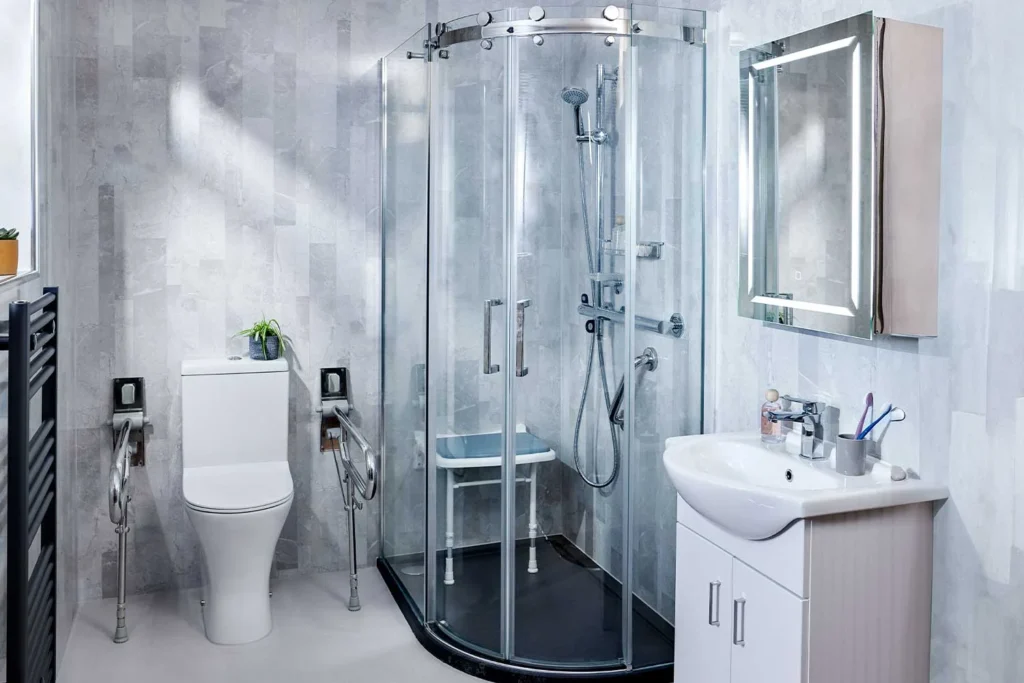
A level-access shower or walk-in shower can provide easier access and remove the need to step over a high edge.
This can help make showering more straightforward and may also reduce some of the risks associated with climbing in and out of a bath.
A spacious shower area may also make it easier for a family member or carer to provide assistance when needed.
3. Think about shower seating
Standing in the shower can be tiring or uncomfortable for some people.
A shower seat can provide a safe and comfortable place to sit while washing, particularly for someone who experiences reduced mobility or fatigue.
The most suitable option will depend on the individual’s needs and the design of the bathroom, so it’s important to consider how the person currently uses the shower.
4. Make the bathroom easy to see and navigate
Good lighting can make a significant difference in any bathroom.
Dark areas, shadows and sudden changes in lighting can sometimes make it more difficult to judge the space around you. Providing clear, consistent lighting throughout the bathroom can help make the room feel more comfortable and easier to navigate.
It’s also worth considering contrast between important features. For example, making certain fixtures easier to distinguish from surrounding surfaces may help someone identify where they need to go.
The best approach will depend on the individual and their particular needs.
5. Reduce potential slip and trip hazards
Bathrooms naturally involve water, smooth surfaces and confined spaces, which can increase the risk of slips and falls.
When designing an accessible bathroom, consider:
- Removing unnecessary changes in floor level
- Keeping walkways clear
- Choosing suitable flooring
- Ensuring the room is well lit
- Reducing clutter
- Providing support where appropriate
A clear and thoughtfully planned space can make moving around the bathroom easier and more comfortable.
6. Consider carefully positioned support
Grab rails and other support features can provide additional stability when they are needed.
However, positioning is important. Support should be placed based on how the individual actually moves around the bathroom, whether that is getting into the shower, standing up from the toilet or moving between different areas.
Support features should feel like a practical part of the bathroom rather than simply being added as an afterthought.
7. Choose easy-to-use bathroom controls
Complicated controls can sometimes make everyday tasks more difficult.
Simple, clearly positioned shower and basin controls can help make the bathroom easier to use. Consider whether the person may have difficulty with grip, reaching or understanding multiple controls.
Where possible, keeping things straightforward can make a real difference.
8. Keep everyday items within easy reach
Storage is another important part of accessible bathroom design.
Frequently used toiletries, towels and personal care items should ideally be easy to access without excessive bending, stretching or searching.
A clutter-free bathroom can also make it easier to see and find important items.
When planning storage, think about the person’s daily routine and the items they use most often.
9. Create a calm and comfortable environment
Bathrooms don’t need to look clinical to be accessible.
Creating a calm, comfortable environment can help make the space more pleasant to use. The choice of lighting, layout and finishes can all contribute to how the room feels.
At AJT Showers, we believe accessibility and style can work together. A bathroom can be practical, supportive and still feel like a beautiful part of the home.
10. Think about future needs
Alzheimer’s is a progressive condition, which means a person’s needs may change over time.
When adapting a bathroom, it can be helpful to think not only about what is needed today but also about what may be needed in the future.
Future-proofing a bathroom could include:
- Creating more space to move around
- Choosing a level-access shower
- Allowing space for a carer to provide assistance
- Considering future mobility equipment
- Installing features that can continue to support changing needs
Planning ahead may help avoid the need for repeated alterations later.
Every person living with Alzheimer’s is different
There is no single bathroom design that is suitable for everyone living with Alzheimer’s.
Some people may experience significant mobility difficulties, while others may remain physically active but experience changes in memory, confidence or perception.
This is why an accessible bathroom should always be designed around the individual.
Before making changes, it can be helpful to consider:
- What does the person currently find difficult?
- How do they use the bathroom each day?
- Are there particular areas where they feel less confident?
- Do they need assistance from a family member or carer?
- Could their needs change in the future?
Understanding these everyday challenges can help create a bathroom that genuinely works for the person using it.
When should you consider adapting the bathroom?
You don’t necessarily need to wait until there is a crisis or an accident.
If someone is beginning to struggle with getting in and out of the bath, feels unsteady in the shower, is becoming less confident in the bathroom or requires increasing assistance, it may be worth considering whether the space could be made easier to use.
Planning ahead can give families more time to explore their options and make decisions without unnecessary pressure.
Creating an accessible bathroom with AJT Showers
At AJT Showers, we specialise in designing and installing accessible bathrooms, walk-in showers and wet rooms.
We understand that every customer has different needs. That’s why we take the time to consider the individual, their home and how they use their bathroom before creating a design.
Our aim is to create bathrooms that combine accessibility, comfort, safety and style — helping people continue to enjoy their homes for as long as possible.
If you’re considering adapting a bathroom for yourself or someone you care for, we’d be happy to discuss your requirements.
September 2, 2026
Living with Alzheimer’s can make familiar everyday routines more challenging...

August 10, 2026
For someone living with Parkinson’s, everyday tasks can become more...

July 14, 2026
One of the most common questions we're asked is: "Can...

May 27, 2026
The recent UK heatwave has been relentless, and for those...
Get In Touch
Opening hours
Monday - Friday 9:00am - 5:00pm
Saturday Appointment Only
Sunday Closed
Give us a call
0800 001 6649Send us an email
enquiries@ajtshowersltd.co.ukVisit our showroom
Unit C3, Riverside Industrial Estate,
Bridge Road, Littlehampton, BN17 5DF
Areas We Cover
We proudly serve the South East of England, specialising in accessible bathroom design and installation across a wide range of locations. Whether you’re in a bustling town or a quiet village, our expert team is nearby, ready to bring your vision to life with empathy and professionalism.
No matter where you are in these areas, we are committed to delivering accessible, bespoke bathrooms tailored to your needs with a local touch and expert care. Contact us for more information today to arrange your free home visit and discover how we can make your bathroom safer and more comfortable.
Call us on 0800 001 6649